
Case Studies
Continuous Professional Development (CPD) — A UNICEF Project
VATT — from scattered paper trainings to a teacher academy in every pocket
<p>The Problem</p><p>A province the size of a country. Tens of thousands of teachers expected to keep</p><p>their skills current. And a training system that barely reached them.</p><p>The intent was there. The infrastructure wasn't — and good intentions don't scale</p><p>across 30+ districts of mountains and distance. The fix wasn't to run more</p><p>workshops. It was to remove the distance entirely.</p><p>- <strong>Training didn't travel.</strong> Professional development happened in person, in a few</p><p> cities. Teachers in remote districts were effectively cut off from the courses</p><p> meant for them.</p><p>- <strong>Content lived in chaos.</strong> Instructors distributed material over WhatsApp groups,</p><p> USB drives, and printed handouts — with no version control and no way to know who</p><p> had actually received it.</p><p>- <strong>No one could prove completion.</strong> A teacher could finish a course and walk away</p><p> with nothing verifiable. Programs had zero visibility into who enrolled, who</p><p> finished, and where people dropped off.</p><p>- <strong>The bandwidth reality.</strong> Broadband penetration across Balochistan sits below</p><p> 20%. Standard video-heavy platforms simply don't load on a 2G/3G connection.</p><p>- <strong>The language wall.</strong> Mainstream LMS products are English-only — excluding the</p><p> majority of Urdu-speaking teachers and trainers from day one.</p>
<p>Results</p><p><strong>Training that finally reaches everyone:</strong></p><p>…
UNICEF — Country Programme (CPD), in partnership with the Government of Balochistan
RLCP
<p>A remedial-learning programme spread across 6 districts, 33 clusters, 341 schools, and 336 learning centers in Balochistan — reaching 16,000 students through 718 tutors — was being monitored on paper. Attendance registers, student progress, and classroom quality were handwritten at the center, then carried up a chain of coordinators and managers — slowly, and with no way to verify any of it.</p><p>Nobody was lying on purpose. But a paper process at this scale can't be trusted, and a donor funding outcomes for 16,000 children can't act on data it can't verify. The fix wasn't more supervisors. It was removing the points where the truth could quietly go missing.</p><p>- No proof a tutor ever showed up — attendance was self-recorded on paper, so "ghost" presence at a center was impossible to disprove</p><p>- Weeks-old, unverifiable field data — by the time registers reached district managers, the information was stale and impossible to audit</p><p>- Siloed records — attendance, student assessments, and classroom observations lived in separate notebooks with no cross-checking</p><p>- No accountability trail across 336 centers — when numbers looked wrong, there was no log to show who recorded what, where, or when</p><p>- Donor reporting built on trust, not evidence — UNICEF needed verifiable reach and quality data across the whole programme, and paper couldn't provide it.</p>
<p>A programme this size, now visible in real time:</p><p>6 districts, 33 cluste…
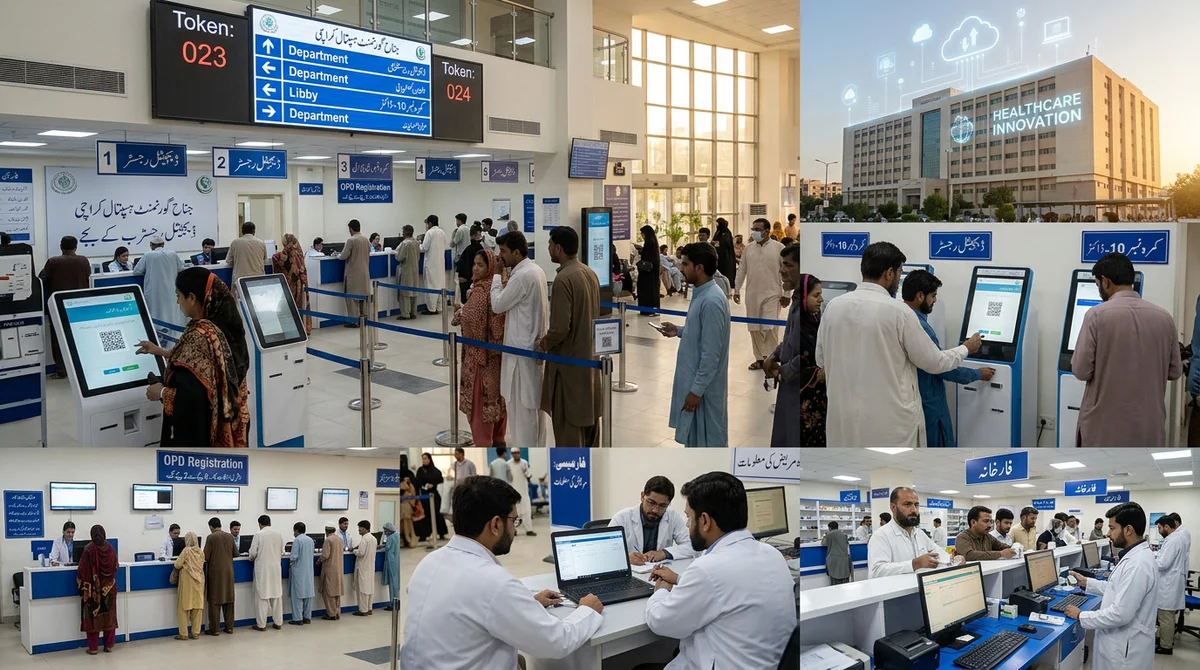
Public Health Department, Goverment Of Balochistan
Civil Hospital Quetta from paper chaos to digital clarity
<h2><strong>A hospital processing 5,000 patients a day was still running on handwritten prescriptions and paper queues. People were getting the wrong medication. Nobody was accountable. We fixed it!</strong></h2><p></p><p>Not because the staff didn't care — they did. But a broken process at scale will always beat good intentions. The solution wasn't to work harder. It was to remove the human error points entirely.</p><p><br>Doctors wrote prescriptions by hand — at scale, illegible or misread scripts led directly to wrong medications reaching patients</p><ul><li><p>Patients queued physically at pharmacies with paper slips, creating bottlenecks and a high risk of document loss or swap</p></li><li><p>No centralized record system — appointments, prescriptions, and dispensing were siloed with no cross-verification</p></li><li><p>Corruption exposure — manual handoffs with no audit trail made it easy for medications to be diverted or duplicated</p></li></ul><p></p>
<h3><strong>Medication errors eliminated:</strong></h3><p> Digital prescriptions…